

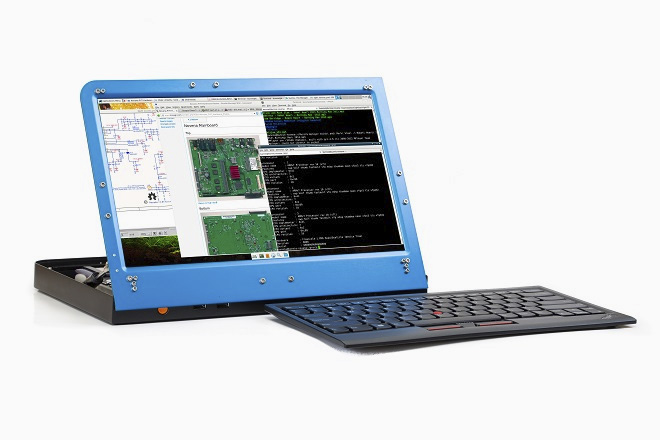
The Novena is an open source laptop in the final stages of design and fundraising.
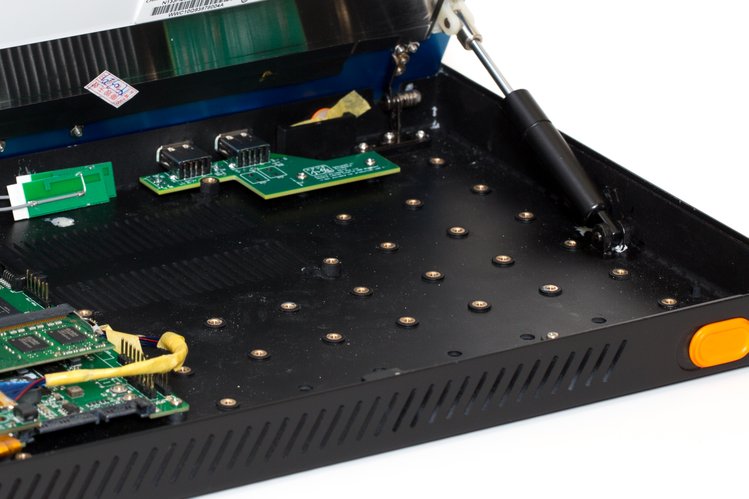
Inside
the open source Novena's laptop case, which opens via a slide latch and
gas spring, is an array of mounting holes to accommodate optional,
third party and user designed peripherals and components, including the
proposed Myriad-RF module.
Earlier this month the dream of a fully open source laptop took one step closer to becoming a reality with the launch of the Novena crowd-funding campaign. In the Myriad-RF project we'd been keenly following Novena developments for some time, and the campaign is all it took to convince us that we should adapt one of our SDR transceiver designs to enable use with the platform. And I'm happy to report that we were able to! But first, let's take a closer look at Novena.
A hackable open hardware computing platform
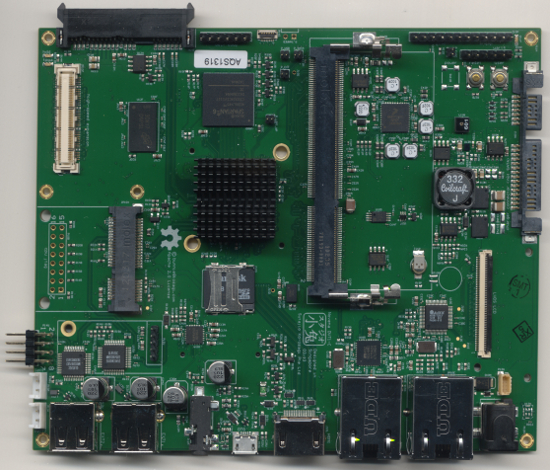
Novena's main board.
-
Quad-core ARM Cortex A9 CPU with NEON FPU @ 1.2 GHZ
-
64-bit, DDR3-1066 SO-DIMM slot
-
SATA-II (3Gbps)
-
Mini PCI-express slot, and UIM slot to enable mobile data card support
-
Dual-channel LVDS LCD connector with USB 2.0 side-channel for a display camera, plus resistive touchscreen controller
-
Stereo 1.1W 8 ohm speaker connectors and optional digital microphone
-
3-axis accelerometer
-
3x internal UART ports
-
1x Gbit Ethernet port plus 1x 100Mbit Ethernet
-
2x USB 2.0 plus USB OTG
-
Spartan-6 FPGA and high-speed I/O expansion header.
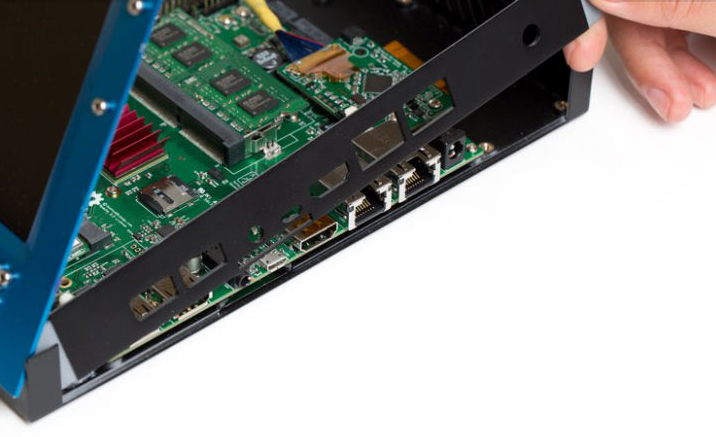
Peripherals and components that require external ports can be accommodated by a replaceable side panel called the “port farm.”
For simple expansion USB can be overkill, while for certain more advanced applications it may introduce a bottleneck or present certain challenges. This is where the high-speed expansion header comes in, which provides plenty of general purpose I/O (GPIO), alongside an FPGA which has interfaces to the CPU that run at up to 2 Gbit/s. Within the Myriad-RF project this in particular piqued our interest, as it meant that it should be trivial to interface a software-defined radio (SDR) transceiver which is attached to the header and with “glue logic” implemented in the FPGA.
Before I get on to the Novena RF module, a quick introduction to Myriad-RF.
Democratising wireless innovation
The
Myriad-RF 1 is an RF module that can be used on any frequency between
300 MHz and 3.8 GHz, with bandwidths of 0.75 to 14 MHz, which has one
transmit and one receive port and with a digital interface for
configuration and transferring data.
The Myriad-RF 1 is complemented by an interface which enables use with a DE0-Nano FPGA development system, and a new board which allows use with any system that has an FMC or HSMC header, such as the ZedBoard. Other projects include the A2300 MIMO platform which is designed for communications, position and timing applications, and the currently incubating RASDR project which is building a high performance, low cost radio astronomy receiver.
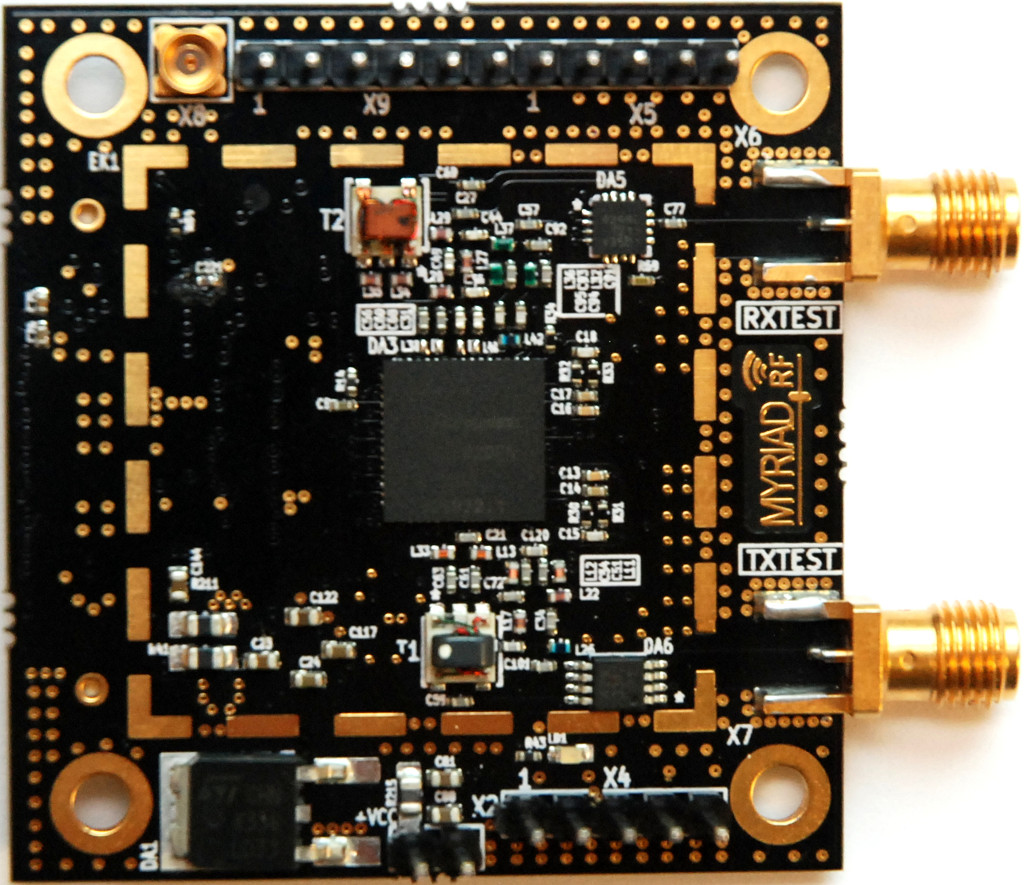
An RF module for Novena
Since the design files for Novena were freely available we were able to quickly ascertain the effort involved in creating a compatible version of the Myriad-RF 1 module. By pure coincidence and much to our delight, it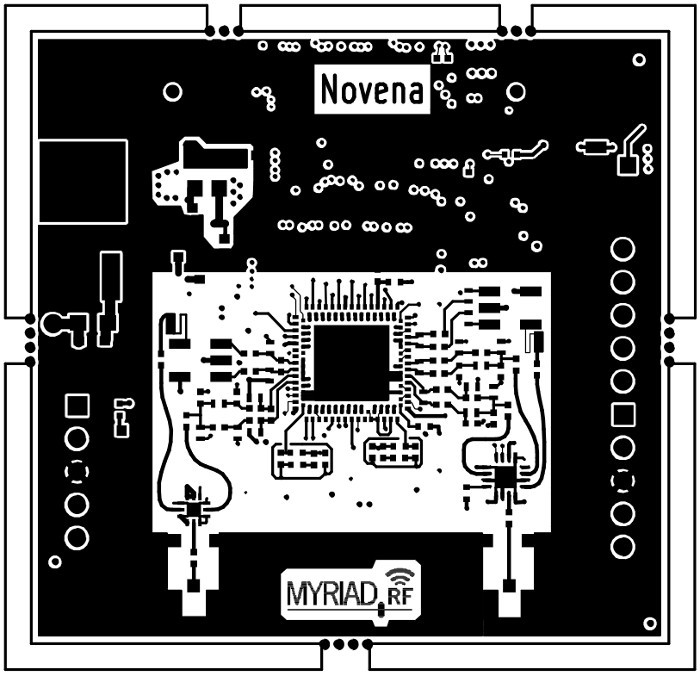
Since
the design files for Novena were freely available we were able to
quickly ascertain the effort involved in creating a compatible version
of the Myriad-RF 1 module.
Further development work remains to be done, but this is mostly a matter of writing the HDL for the “glue logic” to be implemented in the Novena's FPGA, along with a Linux device driver.
Applications
Typical SDR applications which could be supported by Novena plus the RF module include:-
GSM base station
-
Amateur radio transceiver
-
Spectrum analyser
-
Global navigation system
-
Aircraft transponder receiver.
Stretch target
At present the Novena/Myriad-RF module is little more than a design, the bill of materials, CAD and manufacturing files for which can be found on GitHub. However, when we showed this to Bunnie he was just as excited as we were and the module has now been added to the crowdfunding campaign as a stretch target: if $500,000 is raised or there more than 200 backers in total pledge for the Desktop, Laptop and Heirloom versions, each of those backers will also receive an RF module.Due to the nature of the board and setup costs for assembly and testing, 200 is the minimum volume at which it's viable to produce — and this is also after pulling some strings and favourable pricing from suppliers.
We've now got our fingers (and toes!) crossed that one of the stretch targets is met, we're able to put the RF module into manufacture and they're included in the rewards for the top 3 tiers. However, all is not lost if that does not turn out to be the case, since the hardware design is done and we can reassess demand later in the year once the rewards ship and Novena goes into general availability.
Linux.com
Andrew Back is the Myriad-RF Community Manager.

No comments:
Post a Comment